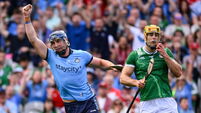
Jack Anderson: No final replay an own goal for hurling

PENALTIES: Cork's Alan Connoll celebrates after scoring a penalty in the penalty shoot-out. Pic: Piaras Ó Mídheach/Sportsfile

With the provincial finals over, it’s time to reflect briefly on the hurling championship thus far.
Cork deservedly took the Mick Mackey cup south on Saturday. The rules provided that the game had to end on the night but penalties to resolve a provincial final should be no more. It’s tough on the players and restricts national exposure of the game in an already condensed season.
The sporting market is now so competitive that even the most established of sports cannot take their audiences for granted.
If you slip to the sporting shadows, you usually stay there. The Epsom Derby also held on Saturday (and also won by a Corkman) is a case in point, 22,000 was one of its lowest attendances in its 246-year history.
There is also the issue of revenue. To remain financially viable, most major sports rely on broadcasting rights upon which they leverage advertising and sponsorship. For the GAA, without any international element, the revenue pool from such sources in shallow. The Association and its provincial councils still rely heavily on ticket sales.
Not having a replay, in what would have been a sell out in Páirc Uí Chaoimh, means the GAA misses out on a week of marketing and publicity; it means that the Park is unlikely to be full again this year (at least not for a GAA game); and Munster GAA is down €1 million plus in revenue. And remember, the revenue generated goes to clubs.
Speaking in 2023, the then Munster GAA treasurer Dermot Lynch made that point that the gross gate for the 2022 final was €1.23 million, and that in the previous three years the Munster Council alone was able to distribute €930,000 in club development grants. The grants for all, not the grab all association.
The argument that penalties are rare and dramatic doesn’t hold up. They might be but the same can apply to replays. Since Mick Mackey won his last Munster title with Limerick in a replay in 1940, there have only been six replayed finals.
Some have been the most memorable in provincial history. Ring beating Limerick with a last-minute goal in 1944, Cork then going to win four in row All-Irelands; Tipp ending the famine in Killarney in 1987; Clare and Waterford and the “Schemozzelle in Semple” in 1998.
Read More
If penalties are to be the tiebreaker in hurling, can we not come up with a version that reflects the skills of the game?
How about adapting from the penalty routine in hockey: the attacker gets a chance to run with the ball in a one-on-one situation with a defender, who starts on the goal line with the goalkeeper.
When the whistle is blown, both the attacker and defender can move, and the attacker has eight seconds to score a goal. If the attacker fouls the ball or doesn’t score in eight seconds, they fail. If either the defender or goalkeeper intentionally fouls the attacker within the eight seconds, a penalty stroke from the 14 is awarded.
In the first half of last Saturday’s Munster final, the referee, Thomas Walsh, blew six frees, one for every title Limerick had won in a row. Walsh, the frustrated PE teacher having to oversee an exam hall on a rainy day, supervised proceedings loosely.
At times the match was like Kendo (the Japanese martial art) with balls; bamboo sticks flying everywhere. The players took to it.
The crowd loved it. In the first half when the rules were more discretionary than mandatory, it probably was overly permissive but that’s like criticising King Henry’s army for using too many arrows at the Battle of Agincourt. That’s war, the game’s afoot.
The problem, when the spirit of the rules overrides the letter of the law, is that every sideline thinks the Holy Spirit is on their side.
Inevitably, things got heated on the line to an extent that no one would have blamed the fourth official if he had done what one East German guard did when the Berlin Wall was being built - hop the wire and run to avoid the gathering storm.
The storm broke at the half-time break when both management teams marched across no man’s land towards the referee. Some sort of control will have to be exerted on hurling sidelines, either by adopting football’s dissent rule and/or forcing management teams to sit but allowing them to use a runner to get their message onto the field.
Will bans follow? Recent comments by Davy Fitzgerald about a referee saw him receive an eight-week ban for misconduct that discredited the Association. And, depending on what the referee reports, there is a specific provision in the GAA rule book that threatening or abusive conduct towards an official should be penalised with a 12-week ban.
The bigger issue with sideline behaviour at inter-county level is that it is often mirrored at club level where some managers adopt the same mad-eyed Antonio Conte approach to their sideline performance.
Saturday’s game was beautifully riotous. It left you drunk and disorderly without having to take a drop, but as fans flared onto the pitch, it only takes one riled-up idiot to also march up to the vulnerable referee.
Even before the penalties, some Limerick supporters were perplexed (that’s as polite as I can put it) at the four extra minutes played by James Owens. The prosecution of James Owens on a charge of poor timekeeping did not however survive the barrister-like defence by Brendan Cummins BL on the Sunday Game.
The extra time was justified. It could be something the GAA itself thinks of more - publishing brief video-like explanations of key refereeing decisions.
The focus now switches to the All-Ireland series. The experiment that is the Joe McDonagh finalists going into the Liam MacCarthy must soon end. The most difficult job in hurling this week rests with Laois, who have six days to prepare for Tipp.
Permitting the losing finalises in the secondary competition, who by virtue of that loss must stay in that secondary competition but can still play in this year’s primary competition, makes about as much sense as this sentence.
Some sort of super eight competition between the top four in Leinster and Munster and based on the AFL finals system would be preferable. Based on this year that would mean: Cork v Galway and Kilkenny v Limerick with winners directly into All-Ireland semi; losers get a second chance to make semis in games against the winners of Tipp v Wexford and Clare v Dublin.
This rewards a county with a second chance if they get to a provincial final. It keeps extra teams who started in the Liam MacCarthy in the All-Ireland series, but makes it, rightly, difficult for them.
Kildare are the story of the hurling season thus far. Their Joe McDonagh success, as all their players noted post-game, was based on the shoulders of club volunteers. And don’t forget Cavan making the Lory Meagher final.
Again, the product of unseen, sustained work. Hurling needs that work, and more. Hurling of the quality we saw last weekend brings joy to so many in Ireland. It is such a unique part of our culture, but the irony is, as with many indigenous games globally, the national sport is a minority sport.