Donegal blood, Mayo heart: Sunday will be complicated for Martin Carney

Martin Carney has ditched the measured analysis from his time with RTÉ for unbridled partisanship in his role with Mid-West Radio. Pic: Barry Cregg / SPORTSFILE
On local radio which has helped him enjoy a reborn appreciation akin to a veteran act that steals the Sunday afternoon at Glastonbury, cheering in that part of the press box isn’t just tolerated, it is mandated.
And so Martin Carney, informed by the industry maxim ‘You’re your audience’, is happy to give Mid-West Radio’s listeners what they want: unashamed partisanship.
While the eloquence remains, the scrupulous objectivity that attended his co-commentary years on RTÉ has been abandoned like an old skin. Martin the Measured is no longer required. He has found his inner Mullane.
It is not an act, fusing this emotional power with his customary descriptive dexterity, as much as he may occasionally ham it up a tad with references and threats of going nude in the unlikely event that Aidan O’Shea at full forward might finally enjoy some service.
Five times Carney co-commentated for RTÉ on All-Ireland finals that Mayo lost, yet you’d never have known of his inner anguish.
After Dublin beat Mayo in the 2013 final, he started his summation, “They (Dublin) fully deserved their victory. Even though there was only a point in it at the end, I thought they were the better team. I’d like to applaud Jim Gavin for the way he has got his team to play [such positive] football.”
Three years later when Dublin won by a similar margin, he again was unfailingly neutral. “It was a fabulous All Ireland final and ultimately a deserved win for Dublin.” In 2017 though when calling it for Mid-West and the outcome and margin was precisely the same, his sorrow was unrestrained. “This is beyond cruelty, this is sadism at its worst,” he lamented while Mayo chased in vain as Dublin played keep-ball to run out the clock.
“It is beyond belief that a team that has given so much is on the wrong side of that result,” he’d add when the final whistle finally put those Mayo players out of their misery – or rather extended it. “They did not deserve to lose that game.” It was heartfelt, that heartbreak. His father was a Mayo man, from Lahardane on the foot of Mount Nephin. His late wife, Gina, was a Mayo woman, from out Ballyhaunis way. His uncle Jackie played on the first Mayo team to win Sam Maguire and trained the last one to win it.
He himself played on the first Mayo team in 12 years to win a Connacht title and in 1989 was part of the first Mayo panel in 38 years to contest an All Ireland final; he was a sub, while just a few further spots down the bench was Gina as team physio. Their four children, his first and only teaching post: Mayo gave birth to them all.
But it was Donegal that gave birth to him. A week like this so when each county’s season is on the line, it’s complicated.
It was the same in 2012 when the prize was Sam Maguire, a trophy his native county had won only once before and his adopted one hadn’t claimed since ’51.
“With mixed loyalties there were mixed emotions,” he says. “For the commentary [with RTÉ], you just went into professional mode, especially when you were doing it nationally.
“When it was over I did feel a huge sadness for the people of Mayo. I played for the county. My wife was physio to the county team for years. I looked after Mayo underage teams for five years. Members of that 2012 panel would have been neighbours. So naturally you build an affinity with the people and the county. But you could never shed that variable that you’re from Donegal, born and bred. And I will always be a Donegal person. So I was thrilled for Donegal as much I was saddened for Mayo.
“Because I can go back all the way to 1963, the first year the county ever played in an Ulster final. I was there that day in Cavan with my late father, God rest him. People forget that: that the GAA was almost 80 years old and Donegal had yet to contest a provincial final. I can remember 1966, the first time BBC televised a provincial final from the north; it was nearly a sop to nationalists at the time. Down beat us in that one as well. And then in ’72 I played in the third final we reached which was the first that we won.” Up to that breakthrough, he elaborates, the sport itself was untraceable in swathes of the county.
“There was hardly any Gaelic football in the Inishowen peninsula. The one strong club was a hurling club: Burt. You’ll hear it as a GAA quiz question: what club has won the most number of senior hurling county titles? Burt, in Donegal. It had a customs post so you had a lot of men from the south on duty there who brought their hurleys with them. But everywhere else on the peninsula was all soccer. The same along the east coast where you had mainly Protestant towns like Manorcunningham and Newtowncunningham.
“Today from Inishowen you’ve the likes of Caolan McGoinigle from Buncrana and Conor O’Donnell from Carndonagh. But it wasn’t until Donegal started winning that the game expanded in the county.” In the south of the county though there was football. And work. That’s what brought Eoin Carney there.
“Dad was an electrician so he followed wherever there was work. In the 1930s he played with Limerick. During the war he worked on the shipyards in Belfast. Harland & Wolff were hardly known for taking on Catholics, to put it mildly, but electricians were so in demand during the war effort they needed him.
“And then after the war you had in Ballyshannon the building of the big hydroelectric station, Cathaleen’s Fall, at the mouth of the Erne. Everyone called it The Scheme, and because of The Scheme, south Donegal thrived.
“That’s how the McEniffs started in the hotel game. Brian’s father, John, was from Monaghan and his mother Elizabeth was a Tyrone woman from Carrickmore and they purchased a bed and breakfast in Bundoran because people were working around there.” Under the management of their sons, Brian and Seán, that B&B by the summer of ’69 had morphed into the rocking Holyrood Hotel, employing as barmen Carney and a promising songwriter called Paul Brady who after his shift would jam with local and visiting musicians.
The football scene was also hopping. McEniff’s hometown had teamed up with Carney’s to form an amalgamated club, St Joseph’s, that quickly started winning all round them. By 1972 they were providing almost half of the county’s starting 15, including its player-manager in McEniff who was only turning 30.
“I think the success we had with Joseph’s gave the county a sense of confidence that it could do something,” says Carney. “And the common denominator in both was McEniff. A player-manager was unheard of at the time. It’s unheard of now. He was just remarkable. His ambition alone. He had this can-do attitude, that nothing was impossible if you put your mind to it.” Carney was the proof of it. As a student in the boarding school in Letterkenny that his mother sent him to “to see whether I’d do any work”, he was “academically a disaster”. What did he go on to do for a living? Become a teacher.
“The big thing at the time was if you could get a job had the two Ps – permanent and pensionable. If you did you were regarded as being set for life.” After doing his BA in maths and English in Galway and then the HDip, he saw in the paper two teaching posts advertised: one in Spanish Point in west Clare, another in Swinford. Swinford was closer to Donegal and only half an hour from where his father was born. He would teach nowhere else.
“I loved it. I think the fact I hadn’t been a great student myself helped me have the patience with people who weren’t inclined to their books.” For five years he’d still make the commute to play with his native county but it eventually wore him down. “I lost all form with Donegal. And a lot of the old guard that I had played with had moved on. And I saw my future down here [in Mayo].” Within three years of making the switch he had captained Mayo to a Connacht title. A year later he and Gina married, buying a house in Breaffy where they’d live the rest of her life and where he still lives now. By the time he finished up with his adopted county shortly after their appearance in the 1989 All Ireland final, he’d won a fourth Connacht medal to go with his two in Ulster. Mayo was good to him.
And he was good to it. In the early 1990s he started coaching Mayo underage teams and guided three of them to All-Ireland finals: the minors in 1991, the U21s in 1994 and 1995. Either Cork or Kerry beat them each time but he still helped bring through a stream of players that would backbone John Maughan’s fine senior team. The likes of Kenneth Mortimer, James Nallen, David Brady, John Casey. Ciarán McDonald.
How did he coach a McDonald? “You didn’t,” he says. “You just let him play. Trusted him to do the right thing with the ball. Because he could see a pass, kick a score, make it sing. Less was more with him.” He won’t say they were close but they did make a connection because they shared one. Donegal.
“Ciarán’s father, Danny, was from Clonmany, a small town on the Inishowen peninsula. And on a Saturday morning we might be training and Danny would be waiting to take Ciarán to work for the weekend on the farm his family had up there. That was a six-hour round-trip. People have this image of Ciarán as being some sort of showpony. The opposite. He would work his bollocks off, whether that was on the family farm, laying down pipe in his day job or practising his kicking.”
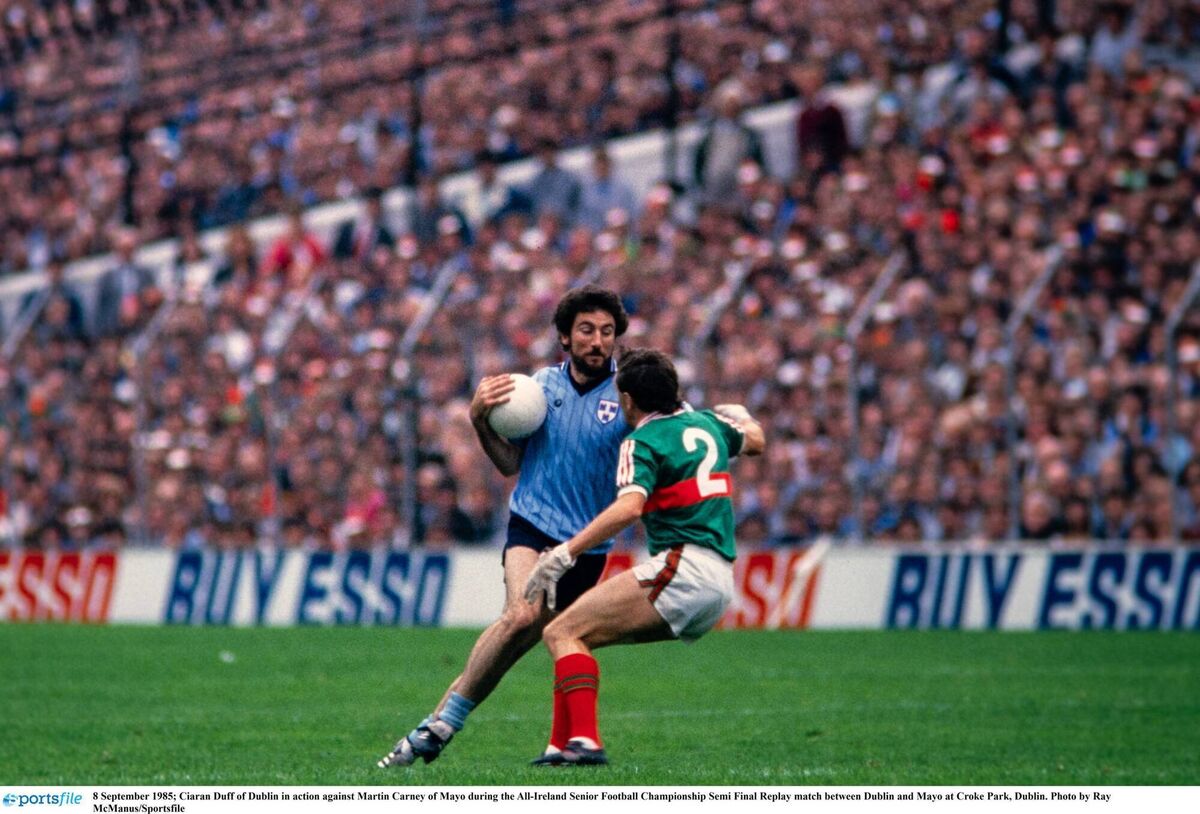
Carney was no average footballer himself. He was remarkably versatile. On the Donegal team of the millennium he was selected at right half forward. When they won their second Ulster final in 1974, he was at midfield, outplaying Frank McGuigan. By 1985 when Mayo first re-announced themselves as a national force, he was playing at corner back in their thrilling couple of All Ireland semi-finals with Dublin. He could play anywhere. And he saw everything. While he’s a footballing romantic, he won’t romanticise it all.
His hero – and he uses that word, though the man was a contemporary – was Jimmy Barry-Murphy.
“In 1975 I played for Ulster in the Railway Cup final on St Patrick’s Day. The night before I met Jimmy in the Skylon Hotel [owned by the McEniffs]. The Barrs were just after winning the hurling club All-Ireland and he was well on it, let’s just say. The next day he went out against Ulster in Croke Park, had just six touches of the ball and scored 4-1. Even then I loved how he made the difficult look so simple. He had this way of finishing off moves based on pure instinct and improvisation.” But he can see how football eventually lost Jimmy, and not just because Kerry gained the upper hand over Cork. The game had a tolerance for what should have been intolerable.
“I remember the year after we [Donegal] beat Tyrone in the Ulster final in ’72 we were drawn to play against them in the first round in Ballybofey. One of our players, Neilly Gallagher, was badly done off the ball early on. And after the game, which Tyrone won, we could not get off the pitch. The Tyrone crowd were trying to pelt us with cans and bottles. We had to dash off the bottom end of the pitch, go up along the Finn river and go in the back of Jackson’s Hotel until the guards had cleared all the Tyrone people from the town. Bars had to lock their doors. That’s how violent it was. And the sport itself could be violent on the pitch back then. There was that edge to it.
“And I suppose I wasn’t always great at dealing with it. I’d love to have had the physical strength of a Peter Ford who I played alongside in the fullback line with Mayo in ’85. But you just tried to keep concentrating on playing football. And it was what it was at the time. The same way there was no backdoor: we knew no different. To us, game was much superior to the game that our fathers played.”
What does he make of the game now with its new ‘enhancements’? Carney served on various football development committees through the decades so his admiration for what Jim Gavin’s FRC has done is considerable.
“The new rules have definitely improved the game as a spectacle. I would still love to see more kicking of the ball. The incessant hand-passing nearly devalues the title of the sport. I’m not sure about free-kicks outside the arc being rewarded with two points. Bringing the ball up 50 metres, often for very little, is excessive.
“But the joy is back in the game. There’s more inventiveness. And it has reacquainted us with a fundamental beauty of the game which is high fielding. I mean, part of what attracted me as a young fella to the game was hearing about this guy called Mick O’Connell. It’s been a pleasure to see some of the ball Aidan O’Shea has hauled down this year. Or watching the likes of Rory Beggan and Shaun Patton with these beautifully-propelled kickouts and the resultant contest to win the ball.
As for the current state of Mayo football, it’s hard to know. His dismay over their display against Cavan went viral. For the record, the reason Everest got a mention for where he might as well be climbing naked was because his niece had messaged the day before that she was at base camp, so that’s where that came from. And where did Mayo’s performance against Tyrone come from? “I think after the Cavan game the players looked into their souls. And I just sense that Tyrone might have been a little bit complacent.”
There has been a dramatic falloff in the crowds the team used to draw. Less than 7,500 were in MacHale Park for the Cavan game. And while there was officially more than 27,000 there for the Connacht final, Carney is sceptical of that figure; it could hardly be said that more people were at a rugby match a few months earlier. “And I’d say of the crowd that was there for the Connacht final,” says Carney, “the ratio was two to one in favour of Galway.”
Swathes of Mayo are struggling for numbers. He thinks of a place like Lacken. Michael Fitzmaurice, the county’s leading scorer in 1989, was from there, as was Michael Collins, that year’s wing-back. The club no longer exists. Instead like several others in the region it’s merged into Kilcummin. “Geographically it’s a huge area but no one is living there anymore. Their manager works in London. He flies into Knock every Friday, then flies out again on Sunday night. People can’t get planning permission to build on the land that they own.”
Still, there is hope, a heartbeat. Kilcummin won the county junior championship last year. The county minors are through to an All Ireland semi-final against Kerry. The U20s recently lost theirs to Louth but featured enough quality forwards for Carney to believe there’s a nucleus of a fine senior team down the line.
As for Carney himself, he keeps trucking on too. He won’t lie: Gina, the physio his old teammate Tommy O’Malley recommended all those years ago that he should see about that hamstring that was giving him trouble, passed away nearly seven years ago now and “it’s still very hard to deal with, especially in the winter when the days can feel long. She was my best friend. I was very lucky in that.” The secret, he has learned, is to “keep busy”. Every morning he’s walking by seven o’clock with the dog, calling by Gina’s graveside along the way. At least once a week he’ll go into the sea for a dip, finds “it’s great for the head”.
The same with the cryptic crossword in the paper he does. For years he sat on the Wild Atlantic Words literary festival alongside Sally Rooney’s mother, Marie Farrell. He’s still part of a male voice choir, interweaving and harmonising with O’Malley just as they used to do on the football field all those years ago. Only last week they played in Ballintubber Abbey, mixing the Beatles with the religious.
And then there’s the radio where the heavenly also can blend with the more profane. When Dublin forwards started hauling their Mayo markers to the ground after Dean Rock’s late go-ahead free in 2017, Carney bemoaned such “messing”. When Paddy Durcan took a page out of the same book upon Ciaran Treacy’s insurance goal in the 2019 league final and immediately wrestled Sean O’Shea, an ecstatic Carney informed his Mid-West listeners that he was watching “two men making love”.
As he says, know your audience.
He’s glad to serve them, just as they’re happy to have him.