Christy O'Connor: Nobody has greater appreciation for Mayo and Donegal rivalry than Padraig Brogan

Mayo 1995 Padraig Brogan © INPHO / Billy Stickland
Midway through the second half of the Mayo-Donegal 1992 All-Ireland semi-final, just after Donegal’s Declan Bonner had missed a free, Croke Park began to stir into a craze, the sudden jolt of electricity running through the ground all connected to the sight of the Mayo number 24, Padraig Brogan, running onto the pitch.
As soon as Brogan handed his substitute slip to referee Tommy Sugrue, the Donegal welcome party lined up to greet him, ramming into Brogan like bumper cars at a fairground as he made his way into the full-forward line to take up his position.
“There’s a lot of pressure on Padraig Brogan coming into this game,” said Colm O’Rourke in his TV co-commentary. “He’s not too popular with the Donegal supporters, management and players after he changed back to Mayo. It will be a big test for him to see if he can produce the goods under such pressure.”
Brogan couldn’t get his hands on the ball while he was on the pitch. Four long deliveries were directed towards him, but Donegal players were constantly hanging out of Brogan and he failed to have a single possession. He eventually snapped. With eight minutes remaining, Brogan caught Matt Gallagher with a high challenge around the neck before pulling him to the ground.
“He’s exacting a bit of retribution I think for some of the holding offences earlier on against him,” said Ger Canning in his match commentary, with 'holding offences' a diplomatic way of describing the treatment being meted out to Brogan, who was booked by Sugrue.
“There seems to be no love lost between Padraig Brogan and any of the Donegal players,” said O’Rourke. “That’s obvious judging from how the tackles are going in thick and fast on Brogan, on and off the ball. As well as that, there’s seems to be a lot of chat between them (Brogan and the Donegal players) on the field.”
In a raw, rough and tension-filled match, Brogan’s arrival into the game sharpened the serrated edge of the blade. Just over four months earlier, Brogan had played for Donegal in a league quarter-final against Dublin in Breffni Park, lining out at midfield alongside Anthony Molloy, who captained Donegal to that All-Ireland.
Dublin got two late goals to win the game and by the time Donegal played again in the championship, Brogan had returned to Mayo because of a personal matter. The next time Brogan met those Donegal players, they told him – in no uncertain terms – that he was playing for the wrong team.
Brogan, who made his name on his iconic goal in the 1985 All-Ireland semi-final against Dublin, was at a loose end in the winter of 1990 when Donegal manager Brian McEniff rang and offered him a job in the leisure centre of the Great Northern Hotel in Bundoran.
Brogan wasn’t playing for Mayo at the time so he transferred to Bundoran from Knockmore and played for Donegal in 1991, coming on as a sub in that year’s Ulster final against Down.
By the following spring, Brogan was far more settled in the team and had established a strong midfield partnership with Molloy. Brogan actually played against some of the Mayo players in the 1992 Railway Cup semi-final for Ulster against Connacht that February. When Ulster beat Munster in the final two weeks later, Brogan was the game’s top scorer from play, bagging 1-2 from midfield.
Brogan would have won an All-Ireland if he’d hung on with Donegal for another few months. His situation is unique in having played with, and against, former team-mates in the same season, all of which makes Brogan more qualified than anyone to describe the cultural similarities between both counties.
“There’s very little difference between Mayo people and Donegal people,’’ said Brogan ten years ago to Kieran Cunningham. “We’re all from similar places. If you travel around Glencolmcille and places like that, it’s very similar to Belmullet or Achill.”
Mayo and Donegal have always had a special connection and tradition of migration between the counties. Mayo natives Paddy Prendergast and John Forde played championship football with Donegal in the 1940s before winning All-Ireland titles in 1950 and ’51 with Mayo.
Martin Carney moved the other way, playing for his native Donegal for nine years and winning two Ulster titles before his job as a teacher brought him to Mayo and he eventually declared for his adopted county, where he won four Connacht championships.
Work took him to Mayo but Carney always had a strong blood connection with the county. His father was a Mayo man who had played for Donegal in the late 1940s, while his uncle Jackie won an All-Ireland with Mayo in 1936 and trained the 1950 and ’51 All-Ireland winning teams.
That cross-county connection has always worked both ways. When Donegal beat Mayo in the 2012 All-Ireland final, three Donegal players – Michael Murphy, Paul Durcan and Martin O’Reilly – were playing against their father’s native county.
The counties have only met six times in the championship but the rivalry got really spiky and bitter when Mayo and Donegal met on three occasions between 2012-15. The attitude Donegal and Mayo have of each other is also largely governed by a historical sense of thinking they’re better than the big county up or down the Atlantic coast. And that opportunity to prove as much is always there anytime Mayo and Donegal meet.
Having worked with Donegal as a coach under Declan Bonner, Mayo stand-in manager Stephen Rochford is ideally placed now to offer the Mayo players an insight into the Donegal mindset. Yet nobody has a greater appreciation of how Mayo and Donegal players think than Padraig Brogan.
In the aftermath of the 2021 Down-Monaghan Ulster U20 final, Conor Laverty was just as focussed on the Monaghan players than the Down players that he had just managed to the Ulster title.
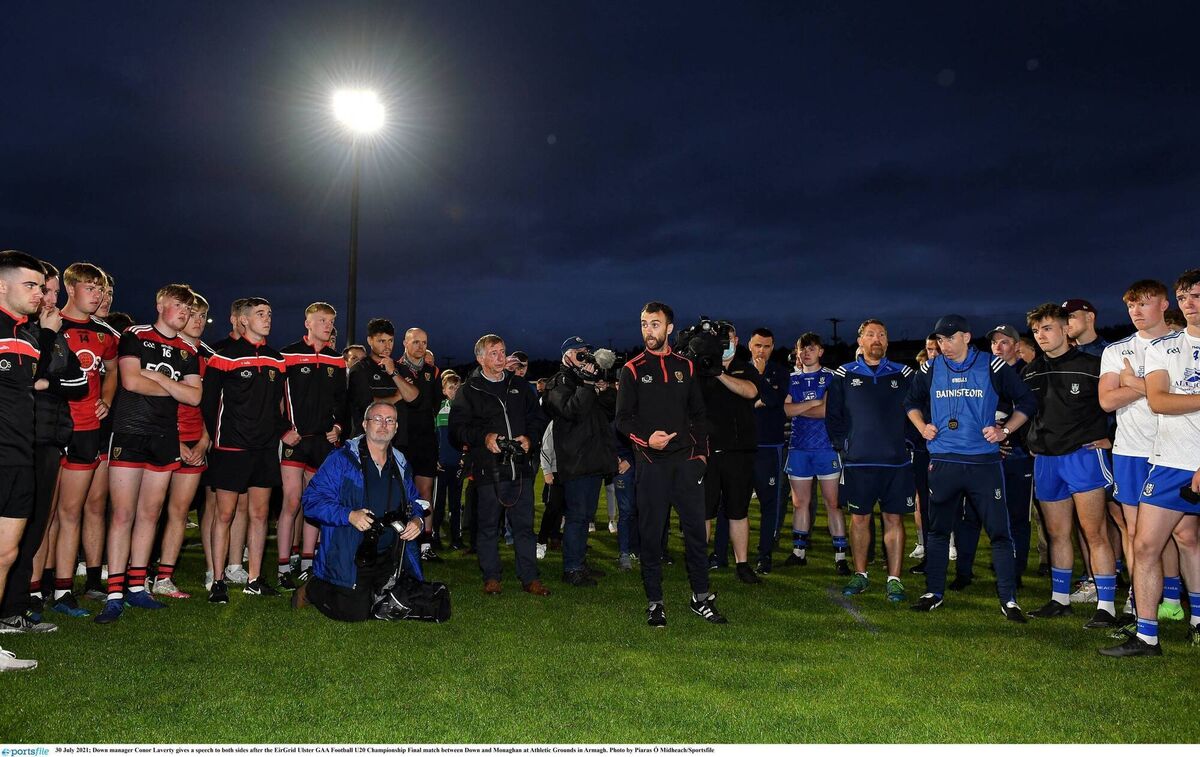
It was the county's first Ulster title at any grade in 12 years, but Laverty was cognisant that Monaghan had lost a lot more than just a game, having spent the previous two weeks grieving for their captain, Brendan Óg Ó Dufaigh, who lost his life in a car crash on his way home from the Ulster semi-final.
Laverty addressed both sets of players in a huddle. A photograph by Piaras Ó Midheach of Sportsfile brilliantly captured that moment of a dignified Laverty surrounded by Down and Monaghan players, along with backroom members from both counties, under the dimming skies of a late summer’s evening.
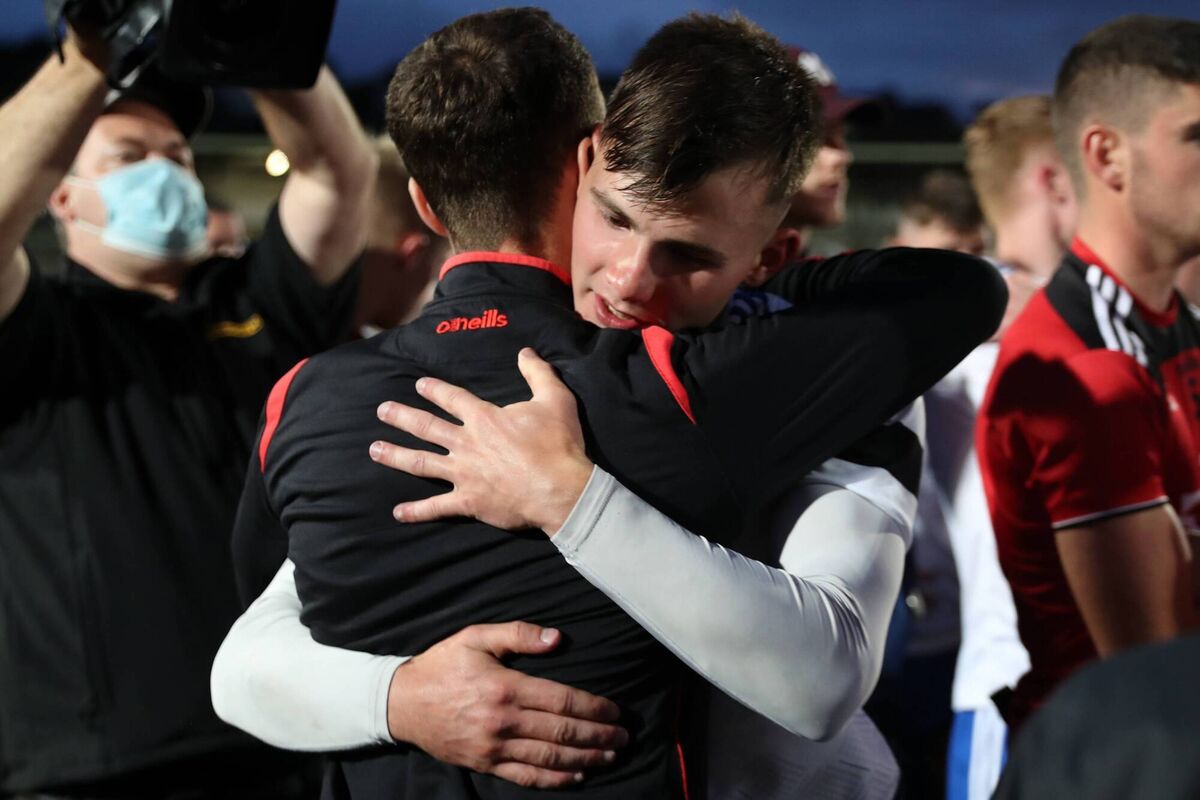
As soon as Laverty had finished speaking, all the Down players respectfully found a Monaghan player to console. As the players exchanged handshakes and hugs, Declan Roughan of Inpho took an excellent photo of Laverty embracing Monaghan’s Jason Irwin.
Laverty’s decency and respect was the defining theme of that evening, but it had a deeper meaning again because Laverty personally knew some of those Monaghan players from having coached the Monaghan senior team the previous year.
Laverty spent just one year under Seamus McEnaney in 2020 before moving on to take over the Down U20s at the end of that year. After Laverty took over the Down seniors in 2023, he brought a raft of those 2021 U20s with him, a number of whom are now some of Down’s key players.
And since leaving Monaghan five years ago, Laverty will face some of those players now for the first time in the championship on Sunday.
A lack of jeopardy with three teams qualifying from a four-team group is an obvious reason, but the Tailteann Cup has still done what it set out to achieve by giving every county the chance to push on and get closer to a big championship day out in Croke Park.
In the four year history of the competition, 16 different teams have reached a quarter-final. Limerick are just one of three teams, along with Fermanagh and Sligo, to have reached three quarter-finals, but the challenge for Limerick and Fermanagh now is to try and make the last four for the first time.
To date, only eight different counties have reached a semi-final – Antrim, Cavan, Down, Laois, Meath, Offaly, Sligo and Westmeath. Antrim, Down, Laois and Sligo have reached two semi-finals, while Sligo (who play Fermanagh on Saturday) are aiming now to become the first county to reach three semi-finals.
Offaly (who face Kildare) and Westmeath (who play Wicklow) are aiming to make the last-four for the second time. Kildare and Wicklow are seeking to reach the last four for the first time, while one of Limerick or Wexford (who meet on Sunday) will definitely reach a maiden semi-final.
Eleven weeks after Limerick and Wexford met in the Division Four final, which Limerick won, the prize has never looked bigger with the winner guaranteed a championship game in Croke Park.