Mick Clifford: Arts Council CEO Maureen Kennelly was an easy target for minister

Maureen Kennelly's contract was not renewed. Instead she was offered a nine-month contract which she rejected. Photo: Tristan Hutchinson
There is a strange and dark interpretation of accountability in the State apparatus.
For those who are on the inside, in positions of power or influence, accountability is a minor obstacle to be avoided. But anybody who is beyond the gilded catchment can, when necessary, be thrown under a bus to quell rumblings of discontent among the masses.
Maureen Kennelly is one such sacrificial figure. Kenneally is an arts administrator and for the last five years was director of the Arts Council. Ordinarily, her tenure would be renewed for another five years as was the case with all her predecessors.
The board of the council was happy with her work, her plans and her vision for the future. But the overseeing minister was having none of it.
Patrick O'Donovan is the Minister for Culture, Communication and Sport, a position that would be best suited to a politician who might have even a modicum of affinity with the arts. Mr O'Donovan’s connection to the arts appears to rely exclusively on his compulsion to wear the costume of the new sheriff in town.
As with many other areas of government an issue has arisen in the arts about overspend of money. In 2018, two years before Kenneally took up her position, the Arts Council set about getting an new IT system installed. The whole process ran into some trouble, involved various contractors and is now the subject of litigation.
Last year, the then minister received a report outlaying how €6.7m had been spent on this project without any real results. There is dispute over how much of that money can be recouped.
The report was only published earlier this year. It followed from various reports about gold-plated bike sheds in Leinster House and a wall that cost more to build than a house and other missives from the Office of Public Works about apparent exorbitant overspends.
So the Cabinet was getting miffed about taking flak for the mishaps and shoddiness of elements of the permanent government. When news of the latest overspend broke, minister O’Donovan declared himself “desperately angry” about it. Simon Harris was reported to be “furious”.
“It is a cause of huge annoyance and anger within government and certainly from my perspective as well,” O’Donovan said.
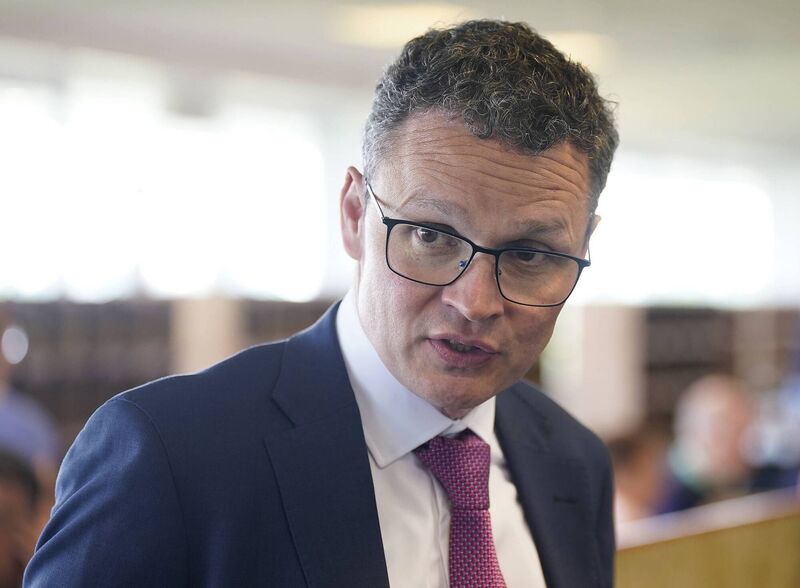
An investigation into what went wrong was established. Then it emerged that the minister was not renewing Ms Kennelly’s contract. Neither would he wait until the outcome of the investigation to decide whether her contract should be renewed. Instead, he offered her a nine-month contract which she, entirely understandably, rejected.
This positioning by the minister is in stark contrast to the standard notion of accountability in either the elected or permanent government when something goes wrong. Usually, nobody is responsible for anything. The real culprit is “systems failure” and “learnings” need to be achieved from any debacle. Move along now, nothing more to see here.
By contrast, Kennelly is thrown under a bus before it can be established what happened. It’s as if somebody, somewhere within government, or the minister’s orbit, came to the conclusion that a head was required to sate any public anger as this was the latest example of waste and nobody anywhere has thus far been held accountable.
On this occasion, there was a perfect target, one of those arty types who, like everybody who works in the arts, doesn’t have security of tenure or the benefit of an employment structure where it’s practically impossible that somebody is held to account for their actions.
Apart from that, the political influence of the arts sector is minimal. It’s not as if you’re throwing under the bus somebody from, for instance, the greyhound or horse racing industries.
Yes indeed the public will understand that arty types just aren’t good with money and no need to look at this any further folks, we have the culprit. Now move along.
On Wednesday last, the Arts Council told the Oireachtas media committee that it “deeply regretted” the minister’s position on Kennelly’s contract. The committee was also told that the department had been contacted by Kennelly or her colleagues 60 times about the ongoing problems with the IT contract and contractors.
Just to repeat that 60, six zero, times. And not once was this concern passed up the line to the most senior figures in the department who would have been mandated to do something about it. Kennelly told the committee that it was “very disappointing and frustrating” that the correspondence was not sent to more senior civil servants.
The committee chair Alan Kelly asked the department’s secretary general, Fearghal O Coigligh why the communications were not escalated. The senior civil servant admitted that it was a, wait for it, “failure” now identified by the department. A failure that recurred 59 times after the first email was received?
“We should have said stop much earlier,” O Coigligh told Kelly, who described the response as “unbelievable”.
“That just sounds like a department that is totally and utterly dysfunctional,” Kelly said.

So now a picture is emerging as to why there was some urgency in throwing Kennelly under the bus. It could well be that the investigation into the matter might, rather than lay the full blame at the Arts Council, highlight shortcomings in a department described at Thursday’s committee meeting as utterly dysfunctional.
At the other end of the telescope of accountability, the reported last week that in the last decade 42 staff in the HSE have spent protracted periods either suspended or on administrative leave. Two such staff have been in that position for 11 years.
Was there no urgency in reaching a conclusion as to whether somebody should be fired, or, as is entirely possible in a minority of cases, put back to working productively? A similar scenario exists in other State organisations such as An Garda Siochána. Short of a criminal conviction, it is nigh on impossible to properly hold a member to account.
Even when there is copious evidence of something that merits dismissal or even sanction, it takes an age to even get close to an outcome. In the interim the person in question continues to draw a salary and pension entitlements, and none of this is attributed to waste.
The rules are different for those outside permanent tenure, irrespective of rights or wrongs. Maureen Kennelly was subjected to de facto summary justice simply because it was possible to do so, a patsy was urgently required and she works in a sector which is beyond the gilded orbit of real political influence.
It’s bad enough that there is no real accountability within the political or permanent government. But throwing under the bus a, by all accounts, competent arts administrator in order that the minister look tough is entirely acceptable to the body politic, where there has not been one iota of resistance, and barely any inquiry.