Kieran Shannon: Penalty shootouts do not suit football and hurling. Here's a better idea

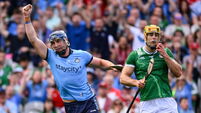
Penalty shootouts suit a low-scoring game like soccer but not high scoring ones like Gaelic football and hurling. Pic: Piaras Ó Mídheach/Sportsfile

There is a reason why the biggest sport in the world has chosen penalties as a tiebreaker: it’s one guaranteed way that someone scores the decisive goal. Any goal.
The first shootout I can remember watching was the 1980 European Cup Winners Cup final. Two glamorous teams – Arsenal and Valencia – featuring glamorous big-name players – Kempes and Brady. The game was dreadful, so much so the mediocrity extended to the penalty shootout and Kempes and Brady.
The star of the 1978 World Cup was Valencia’s first nominated penalty-taker; Brady, the star of the Irish national team and the finest midfielder in England, Arsenal’s. They each missed.
But at least their mishaps provided some drama and eventually the shootout provided a winner. After we’d first heard of the term ‘sudden death’, Valencia prevailed.
The greatest Irish sporting moment ever remains Genoa; when else really has the nation held its breath? We don’t need to repeat the cast of characters involved in that drama as you know them well but we will all the same to warm your heart: Timofte, Packie, David O’Leary.
The following World Cup was decided on penalties and its best player blazing his over the bar. But at least Roberto Baggio’s miss gave us a winner and his anguish as well as his prior brilliance (“This Buddhist who stood only 5’7, weighed just 145 pounds and wore his hair in a ponytail brought an elegance, a grace and an aura of magic that I’d not before seen in any sport,” wrote a captivated Joe McGinniss) spawned the Miracle of Castel Di Sangro.
What did the aforementioned three games have in common?
The teams involved weren’t just deadlocked at the end of normal and extra time. They were all goalless.
They could all have played for a further 120 minutes and there would still be a likelihood each of those games would finish 0-0. A penalty shootout was the one sure way of ensuring there was both a winner and some drama on the day.
There have been multiple other massive football games in subsequent years that have followed in that tradition. AC Milan’s 2003 Champions League win was the fourth in which the finalists were tied 0-0 at the end of 120 minutes; Real Madrid’s in 2016 over neighbours Atletico the 11th final decided on penalties.
Just a few months ago there was another Madrid derby Champions League knockout game decided on a penalty shootout. People cribbed that it hinged on Julián Álvarez being adjudged to have touched the ball twice before it ended up in the net, but not that the contest went to a penalty shootout. In the GAA it’s different. Especially hurling, going by the outcry in the wake of the recent Munster hurling final. All of those penalty shootouts the Armagh footballers lost now seem to have been merely harsh; the one the hurlers of Cork and Limerick were subjected to, a complete injustice.
And in a way people were right to differentiate between the two, though for reasons they would not know, let alone explain as we will in a bit.
But first, let’s establish something. While replays are a preferred method to separate two teams, they are increasingly a luxury. For the betterment of the entire GAA ecosystem, more games have to be decided on the day. The knock-on effects replays have on the rest of the calendar and other constituencies outweigh the pros that they provide.
There are calls for an exception to be made for provincial finals. But in a way a provincial final, especially hurling’s, is the fixture that most needs to be decided on the day.
As it is, the (rightful) retention of the Munster hurling final under the round-robin format considerably slows the rate of matches teams are served earlier in the championship.
Break it down. Teams need and are given at least a two-week gap heading into a Munster final. Whoever loses it requires a further fortnight’s break to have suitably recovered physically and emotionally for their All Ireland quarter-final. And whoever wins that quarter-final needs a two-week lead in to an All Ireland semi-final.
These necessary fortnight breaks either side of the Munster final is why a team like Tipperary, who played four championship games in 28 days, had to then go without a game for 27 days (There’s a rationale, albeit possibly not strong enough of a one, as to why there are preliminary quarter-finals: Dublin and Tipperary, as the third-placed teams in their respective provinces, needed an official game to blow off the cobwebs, otherwise they’d be going into an All Ireland quarter-final five weeks in cold storage).
It’s one of the unspoken reasons why Peter Queally is understandably aggrieved why Waterford aren’t guaranteed to play later into the summer: had you no Munster final in June, his team would be able to play well into the month.
There should still be Munster finals in June. But not Munster (or Leinster) final replays. If we had one this year that would have pushed out the All-Ireland quarter-final by a week, it would have pushed out the winner’s wait for their All-Ireland semi-final from four weeks to an unmanageable and unjust five weeks.
We’ve already seen teams punished for having to take part in a provincial final replay. In 2018 Kilkenny won the national league. In the Leinster final they drew in Croke Park with the then reigning All-Ireland champions, Galway. A week later they were out again, in Thurles, and rallied from 11 points down to get back to within a point before Galway made another charge late on to seal the win. Just seven days later again, Kilkenny had to again to line out in Thurles. They were beaten by two points by Limerick. It’s hard not to think fatigue was a factor down the stretch.
You could argue Galway were also punished for their Leinster final exertions; that it, as well as the All-Ireland semi-final clash with Clare going to a replay, eventually caught up with them in the All-Ireland final.
It makes sense for more – most – GAA games to be decided on the day.
Just not by penalties.
Soccer decides games by penalties because it is a low-scoring sport.
Basketball does not decide games by free-throws. It is a high-scoring sport. If the sides are level at the end of regulation time, it keeps playing extra-time periods of five minutes – three at underage – until there is a winner.
Hurling and football are not low-scoring sports. The GAA should devise a tiebreaking mechanism of its own based on that reality.
Last Saturday week in the Gaelic Grounds after they were level upon the initial 70 minutes, Limerick and Cork scored three points apiece in the first 10 minutes of extra-time, then a further five points apiece in the second period of extra-time.
Picture this. Instead of them then having to select or request five volunteers to take part in a penalty shootout, John Kiely and Pat Ryan are able to send 15 men back onto the field and play what we’ll call First To Three: whichever side gets to three points first wins the game.
Think of that drama. How much more satisfying it would be to conclude the contest with someone scoring that third point – possibly a goal when his team had been 0-2 to 0-0 down – and the excitement and euphoria in the wake of them hitting that built-in walk-off, game-winning buzzer-beater rather than a Declan Hannon trying a shot he hasn’t even practised in a long time and slumping to his knees.
It would take little time for a hurling team to hit that three-point mark. And if you’re worried about how fatigued they might be, allow unlimited rolling subs for that extra period, or indeed the 20 minutes prior to it.
The only potential snag or criticism you could have about it is if there was a considerable wind. But we’ve seen how teams can play better against the breeze, like the Donegal and Mayo footballers in Hyde Park only last Sunday. Even if you think the wind remains a glaring factor, then have the teams swap ends after one of them hits the two-point mark, and-or insist that teams can only score within their own half of the field.
A year ago we would have been less inclined to recommend First to Three as a tiebreaker in football. We’d all seen teams more interested in not losing than winning, avoiding mistakes and turnovers rather than trying to create or take on a score. With all the interminable keep-ball, you could be waiting a lot longer than another 20 minutes of extra time for someone to hit the three-point target.
We have less of that mindset and carry-on now. And to further discourage it, you could always put in a shot-clock of say one minute (Hurling requires no such intervention).
Think that’s artificial, contrived?
It’s a lot less so than taking a tiebreaking model from a low-scoring sport and imposing it on a higher-scoring one.
And much more just and fun.