Make the Kerry Way your office for a day... or three

The Kerry Way is largely off-road with accessible trailheads at points along the N71 Ring of Kerry. Pictures: Simon Tierney
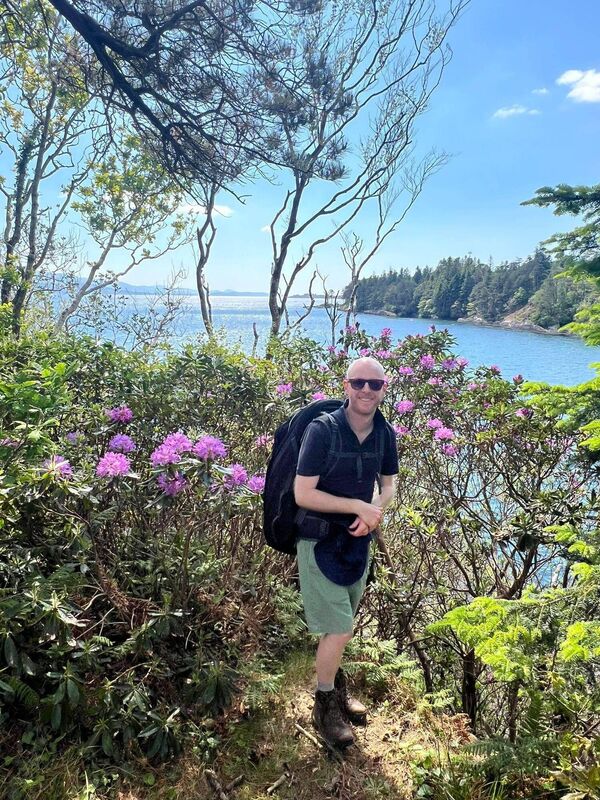
As I made my way down a dusty waymarked path, Scots pine filtering dappled sunlight onto the encroaching rhododendron, a scene more reminiscent of the Mediterranean than Ireland opened up before me. The quiet solitude of a little inlet on the north side of Kenmare Bay reminded me why I had undertaken this 50 kilometre hike along the Kerry Way. A little slice of heaven, that rekindled memories of my childhood holidays in this magical corner of the South West.
The Kerry Way is one of Ireland’s longest and best established waymarked hiking trails, stretching over 200 kilometres around the Iveragh Peninsula, beginning and finishing in Killarney.
Due to the pressures of time, and perhaps a nod to the limits of my athletic ambitions, my hiking buddy and I decided to undertake just the final three sections, from near Caherdaniel to Killarney. This route afforded us nice towns to end each day’s walk, with plentiful accommodation and opportunities for signing off each hike with a pint of stout in some of Ireland’s finest pubs.
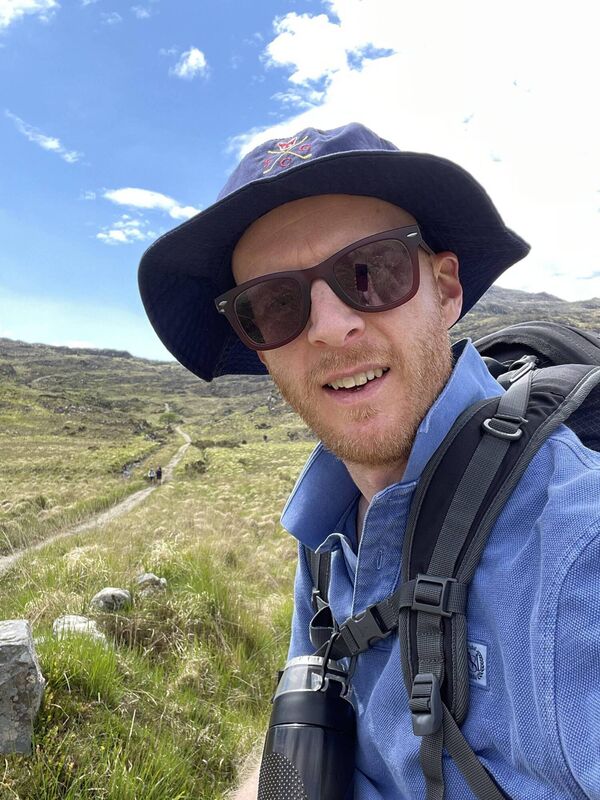
The magic of the Kerry Way is how deftly it transports you across ancient and undisturbed landscapes.
Writing in his walking guide to the Kerry Way, author Dónal Fallon observes that “the Kerry Way is as much an act of time travel as it is of nature watching, bringing you face-to face with the enigmatic monuments of the county’s earliest inhabitants in remote landscapes that have barely changed since the ancestors left their mark".
The Kerry Way is largely off-road. However, it occasionally meets the N71 Ring of Kerry, allowing for accessible trailheads here and there.
We picked up the route on day-one where the Oweragh River converges with this busy highway, halfway between Caherdaniel and Sneem and near to the Iron Age Staigue Fort. An easy and flat hike, with stunning views across to Dursey Head, brought us across fields of bog cotton and errant sheep, before entering the village of Sneem.
An evening in O’Shea’s Bar and a visit to Quills, a shop selling knitwear that I recalled fondly from my original visits to the town 35 years ago, brought an end to the first stage of the journey.
Having hiked 100 kilometres along the Royal Canal Way in 2023 and 70 kilometres of the Burren Way in County Clare last year, I was determined to continue my downward mobility with yet an even shorter route this year along another of Ireland’s stunning waymarked trails.
One of the reasons I do these trips is the opportunity to disconnect from the persistent distractions of modern life and live out Bill Bryson’s maxim of “a walk in the woods”. A bag on my back, and nothing more. While disconnecting from life’s tedium, I also wanted to reconnect with the Kerry which sits in my memory. A sense of the county that was incubated in my family holidays of the 1980s and 90s.
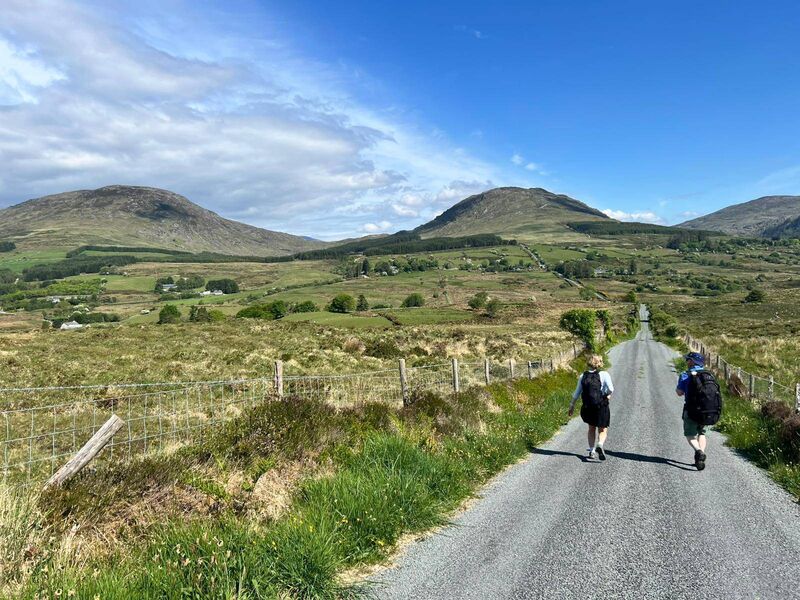
The Kerry Way has been made possible through the extraordinary cooperation of hundreds of landowners, who allow walkers to traverse their properties, and Kerry County Council, South Kerry Development Partnership and the Kerry Way Committee.
The installation of helpful stiles at gate posts keeps things moving. Stepping down from one of these stiles on day-two, as we hiked towards Kenmare, framed with the oft-derided purple rhododendron, I sensed something in the back of my mind. The combination of these plants, the steam rising from the earth, baked in south Kerry’s microclimate, and the presence of the Kenmare River, all transported me back to my childhood. It was nature’s way of grounding me in a sense of place. Something I’d forgotten.
After 20 kilometres, my hiking buddy and I realised we had reached our limit for the day. Yet the bright lights of Kenmare were still seven klicks away. We found a trailhead that collided with the trusty N71 and, in a moment of opportunistic abandon, I thrust out my thumb in the vain hope of a kind motorist taking pity on two weary pilgrims. Much to my amazement, the very first car that passed us stopped. A friendly and chatty local man ferried us to O’Donnabhain’s on Henry St for the customary end-of-hike tipple.
“I’m not sure we deserve this,” my fellow traveller whispered. “Isn’t hitching a lift cheating?”
“Relax,” I said. “I left my Strava on. It’ll just look like we completed the last few kilometres at record speed.”
While the Sneem to Kenmare section of the Kerry Way is articulated by deep forestry, sheep fields and the Kenmare River, day-three brought an entirely new challenge as the landscape evolved towards our endpoint in Killarney. Heading east out of Kenmare, a steep climb eventually brought us into the embrace of Killarney National Park. This was by far the most arduous hike of the trip, with long stretches of undulating and rocky terrain, and boardwalks across boggy land, eventually spitting us out through old, gnarled oak forests at Torc.
The waterfall at Torc, not far from the grounds of Muckross House, marked a dramatic end point to our adventure. The astonishing 66 foot high cascade stopped us in our tracks. After almost five hours of hiking that day, we felt suitably smug surrounded by busloads of Americans who had stepped daintily off their tour coaches, to take photographs of the impressive falls.
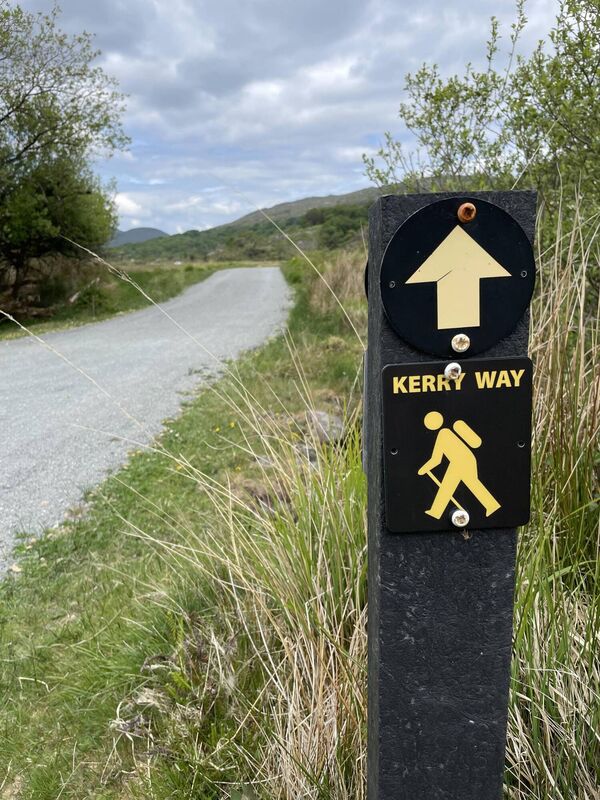
Despite meeting lots of other hikers on day-three, we had been surprised by how quiet our first two days had been. In fact, we had barely crossed paths with another soul. My hiking buddy, who lives in London, quipped, “If this was England, the place would be mobbed.”
His comment got me thinking. We’re blessed with waymarked trails in Ireland, so why are they not more used? Every year we export so many of our trailing enthusiasts to the Camino in Spain and other exotic locales, yet we have our own treasures here at home.